04 · PRODUCT STRATEGY · TRAVEL MARKETPLACE
· 6 min readAgoda FamilyFit
Helping parents choose rooms that fit their baby’s needs.
An independent product concept exploring how Agoda could help parents evaluate exact-room compatibility, understand uncertainty and secure essential baby-related requests before arrival.
Independent concept for Agoda — not commissioned, endorsed by or affiliated with Agoda. Hypothesis-led and unshipped. Primary research is still required before any decisions or claims should be treated as validated.
Role
Product Designer
Company
Independent concept for Agoda — not commissioned or affiliated
Users
Parents travelling with infants and hotel front-office teams
Market
Global travel marketplace
Scope
Hotel search, room selection, request confirmation and property operations
Status
Hypothesis-led, unshipped concept
01 · A family-friendly property can still be the wrong room
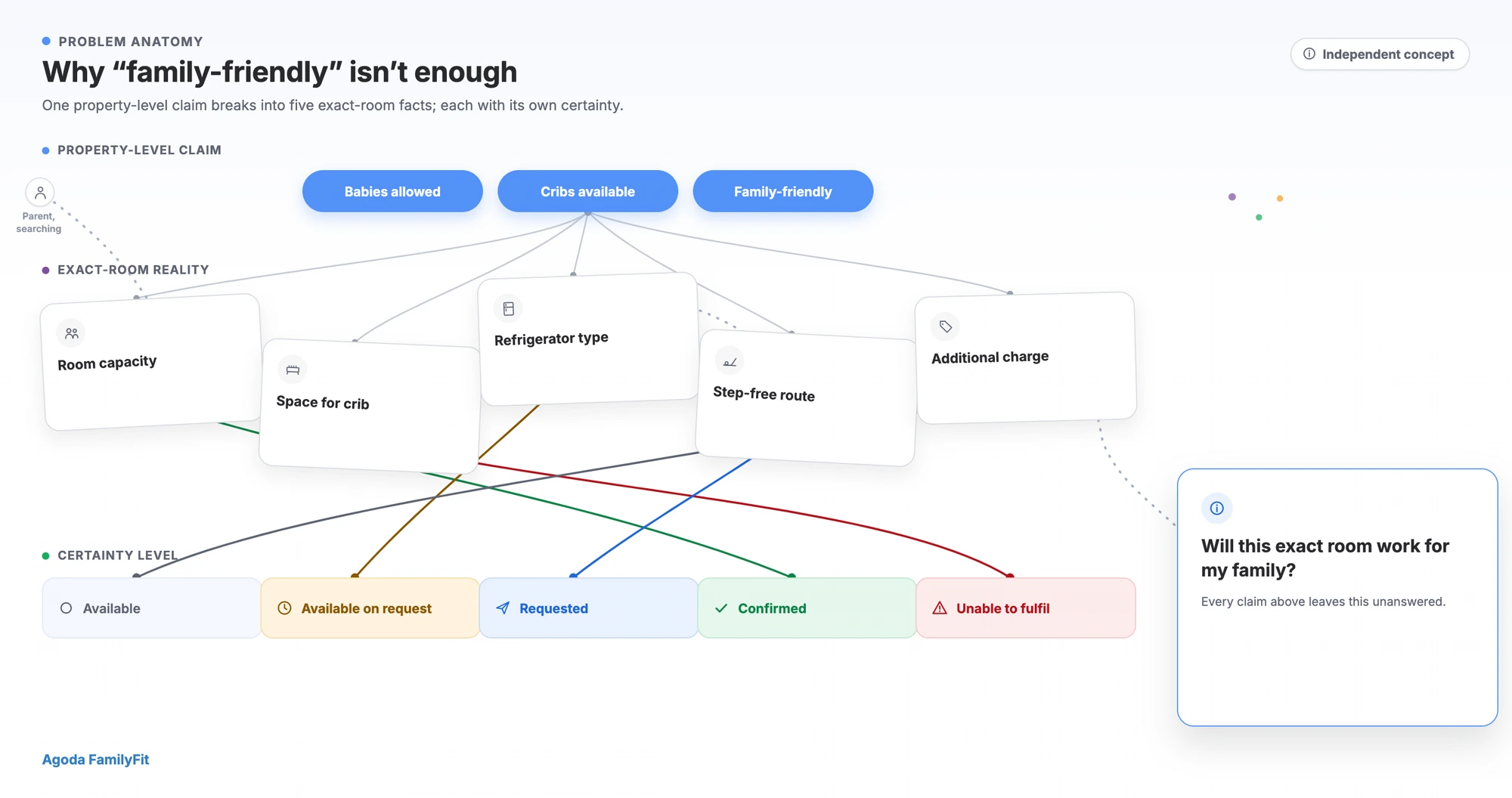
A hotel may accept babies and offer cribs. That does not mean the room a parent is about to book has space for one—or that a crib will still be available when the family arrives.
The same uncertainty applies to refrigerators, elevators, bathtubs, occupancy rules and additional charges.
Parents are not looking for amenities in isolation. They are trying to answer a more practical question:
“Will this exact room work for my family?”
Today, that answer may be scattered across property descriptions, room details, policies, reviews and messages. Even when the information exists, parents still have to interpret what applies to their room and how certain it is.
That led to the opportunity:
“How might Agoda help parents determine whether a property and room can practically accommodate their baby—not simply permit the baby as another guest?”
02 · Existing information was fragmented
Agoda already supports children as a separate guest type, family-related filters, room capacity, amenities, property policies, cancellation options and special requests.
The opportunity sits between those features.
A crib might be listed at property level while the selected room cannot fit one. A request can be sent without becoming a commitment. Occupancy restrictions or extra charges may appear after a parent has already spent time choosing the hotel.
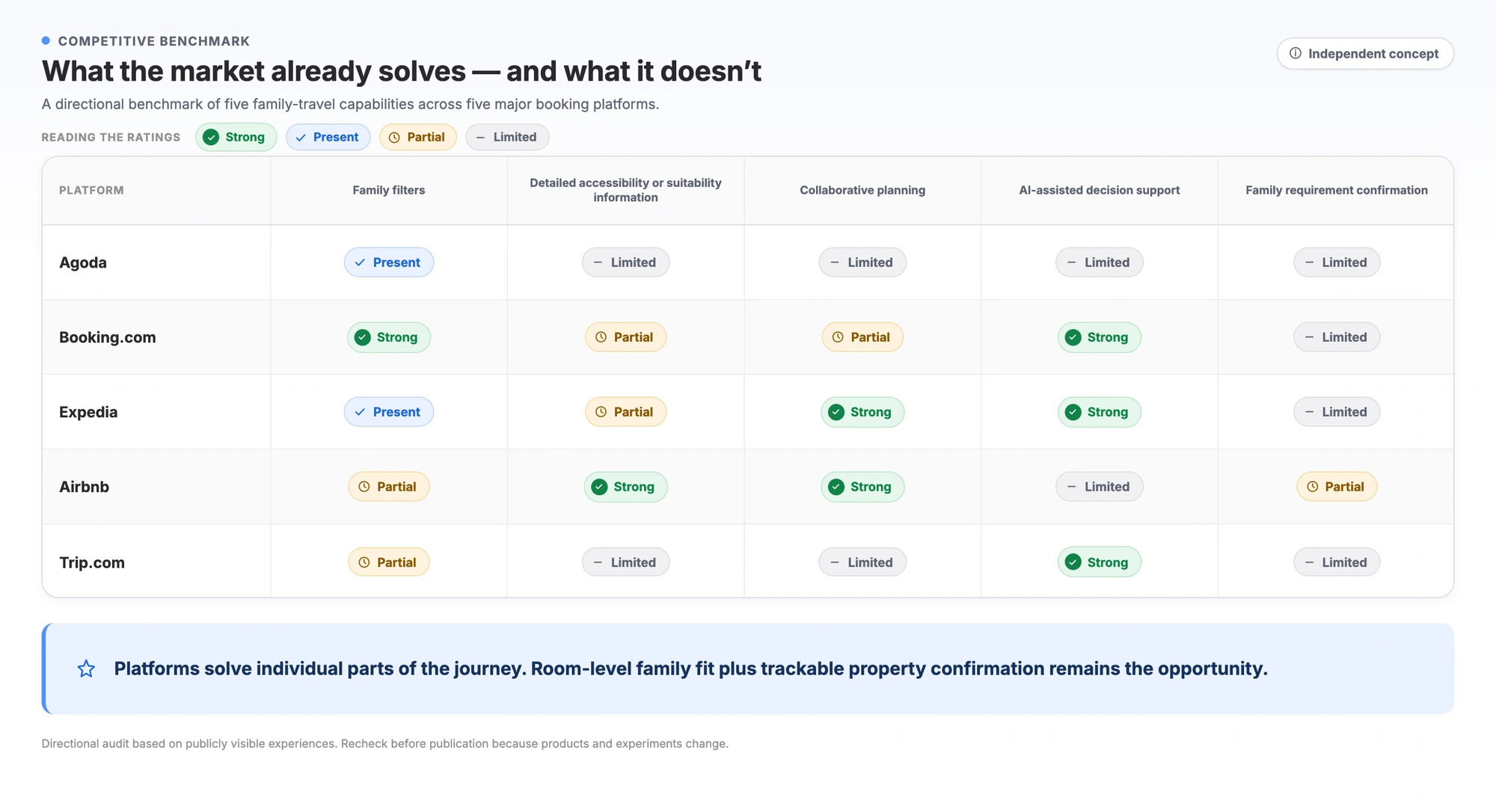
A directional review of Agoda, Booking.com, Expedia, Airbnb and Trip.com revealed a similar pattern. Each platform supports valuable parts of travel planning, but room-level family suitability and trackable confirmation remain fragmented.
The answer was unlikely to be another filter. What was missing was a confidence system.
03 · Public evidence sharpened the hypothesis
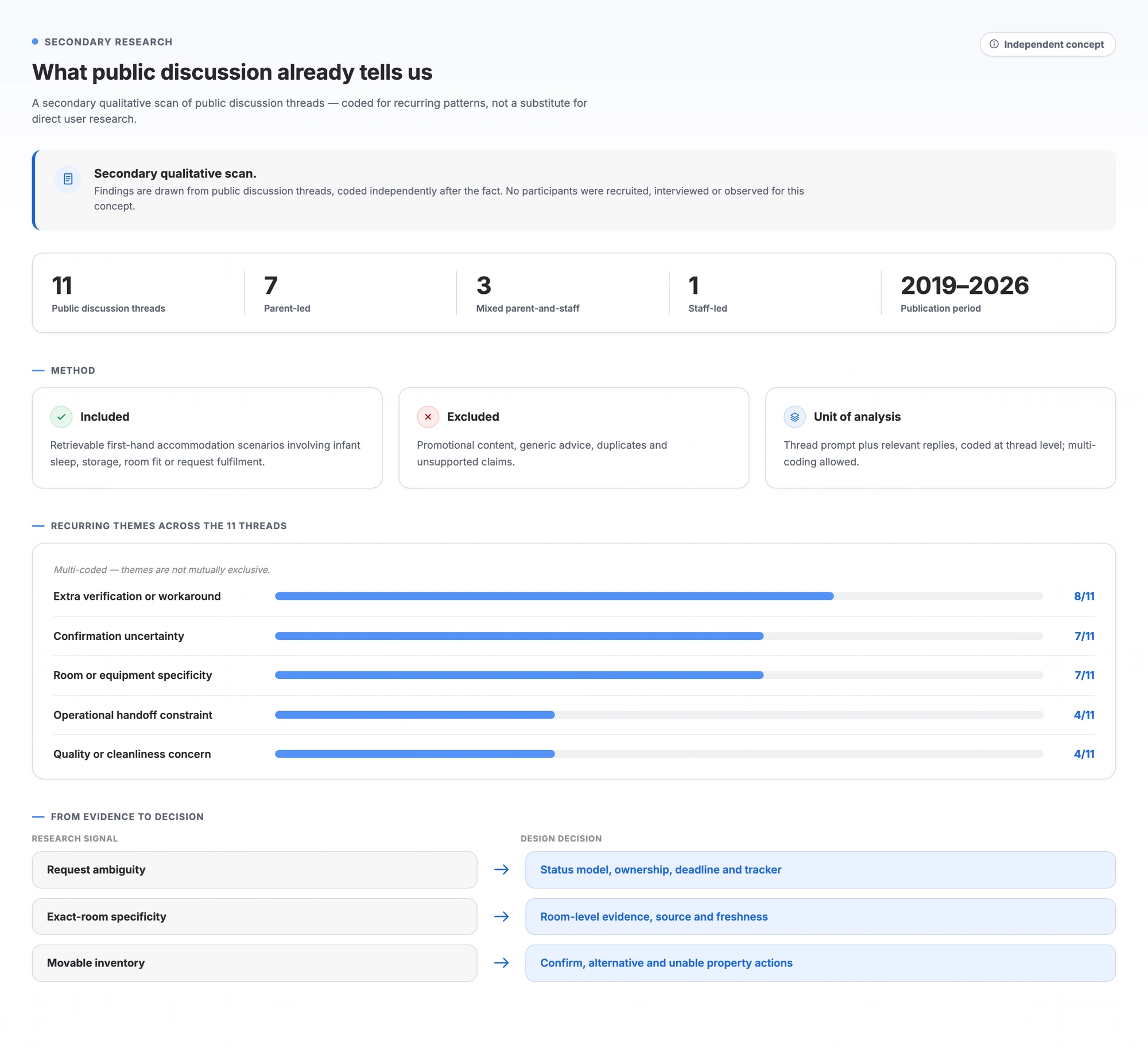
For this exploration, I used a secondary qualitative scan of 11 public discussion threads published between 2019 and 2026.
The sample included seven parent-led conversations, three mixed parent-and-staff discussions and one staff-led operational account.
I included retrievable accommodation experiences involving infant sleep, milk storage, room fit or request fulfilment. Promotional content, generic packing advice, duplicate scenarios and unsupported claims were excluded. Thread prompts and relevant replies were coded together, and a thread could contribute to more than one theme.
Three signals stood out:
- Eight threads described additional verification or a workaround—calling, messaging again, re-confirming or bringing equipment.
- Seven included uncertainty about whether a request was genuinely guaranteed.
- Seven showed that room space, equipment type, availability or condition could change whether the stay worked.
Property-side constraints surfaced too. Limited crib inventory, room changes, housekeeping coordination and shift handoffs all affected fulfilment.
These counts are directional theme occurrences, not prevalence estimates. The posters were not recruited, their demographics were not verified and primary research is still required.
04 · One promise, two operational experiences
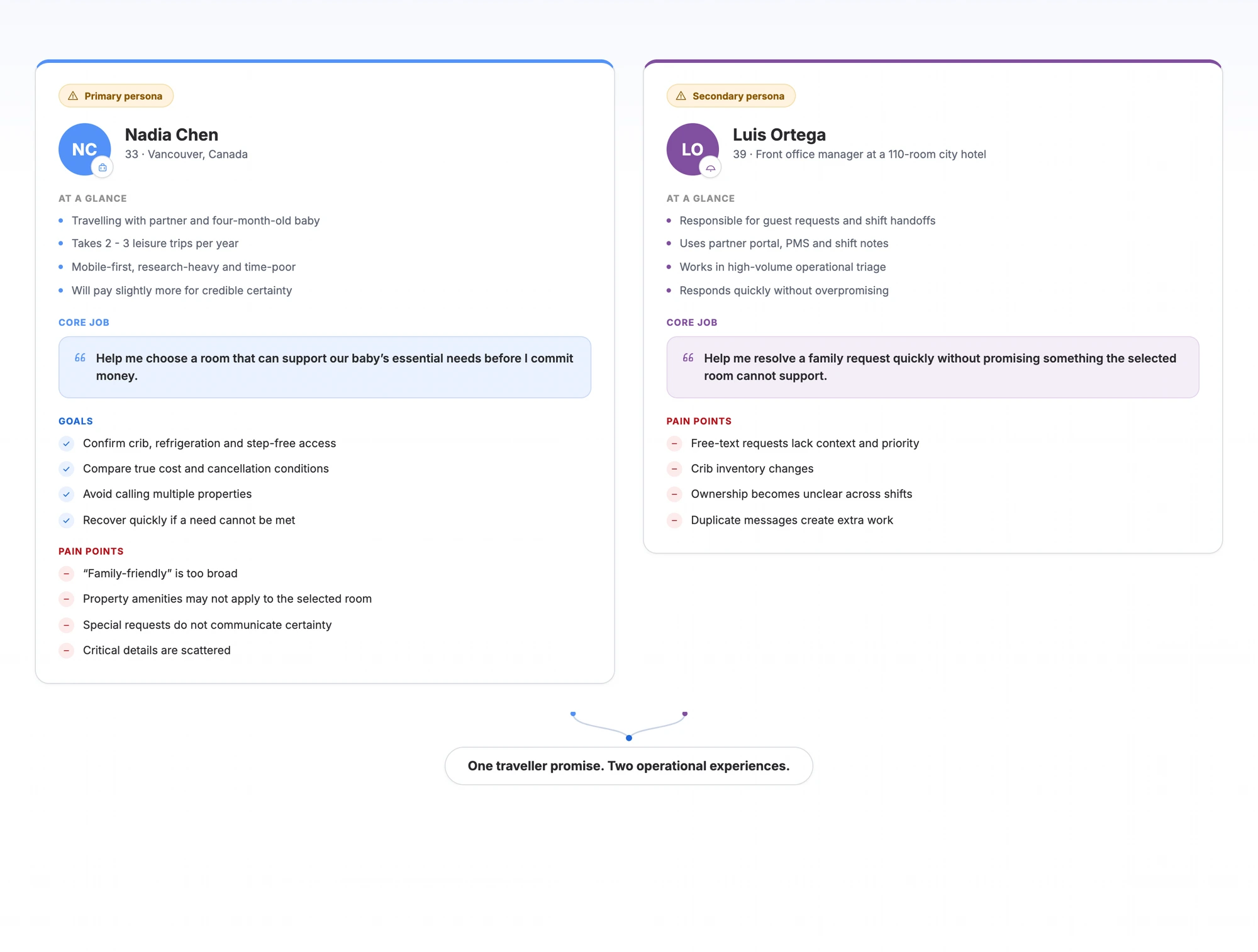
I created two proto-personas to prevent the concept from becoming a traveller-only interface exercise.
Nadia Chen is a time-poor parent travelling with her partner and four-month-old baby. She is prepared to pay slightly more for dependable information, but she does not want to call several hotels before making a decision.
Luis Ortega manages requests at a 110-room hotel. His team works across changing shifts, limited equipment and several systems. He needs enough context to respond quickly without promising something the property cannot deliver.
Neither persona represents an interview participant. They are working models that should change when primary research produces stronger evidence.
05 · Room suitability depends on family, room, property rules and request availability
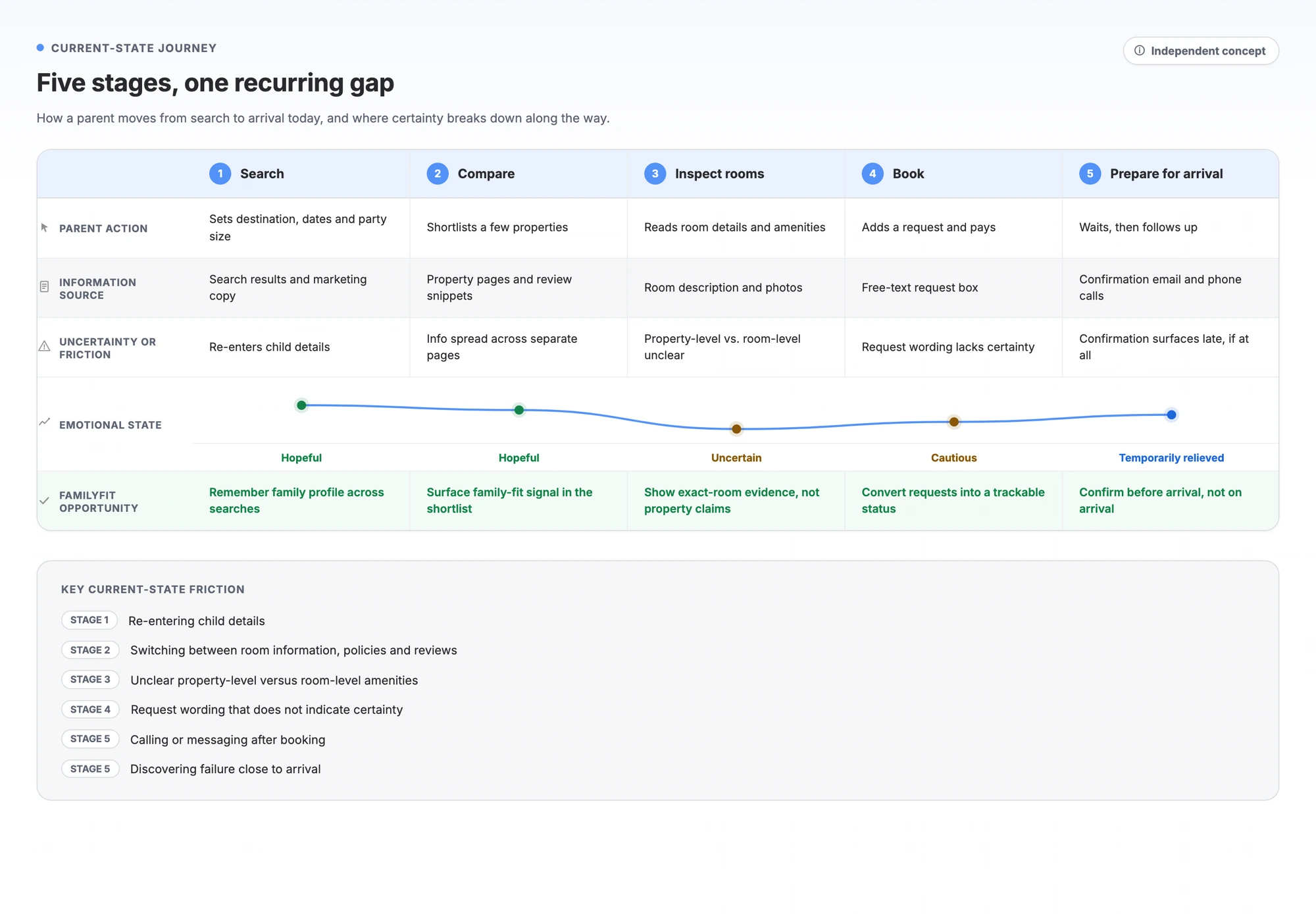
The current journey contains five familiar stages: search, compare, inspect rooms, book and prepare for arrival.
Uncertainty moves through all five.
A parent may re-enter information, compare room descriptions, search recent reviews and message the property—yet still reach arrival without knowing whether an essential request has been secured.
The core insight was this:
“Family suitability is the relationship between a particular family, a particular room, the property’s rules and the certainty attached to each requirement.”
A crib makes the problem visible. It may appear as an amenity, but operationally it behaves like movable inventory. It can exist at the property, be incompatible with one room or be allocated to another family before arrival.
06 · Designing a confidence system
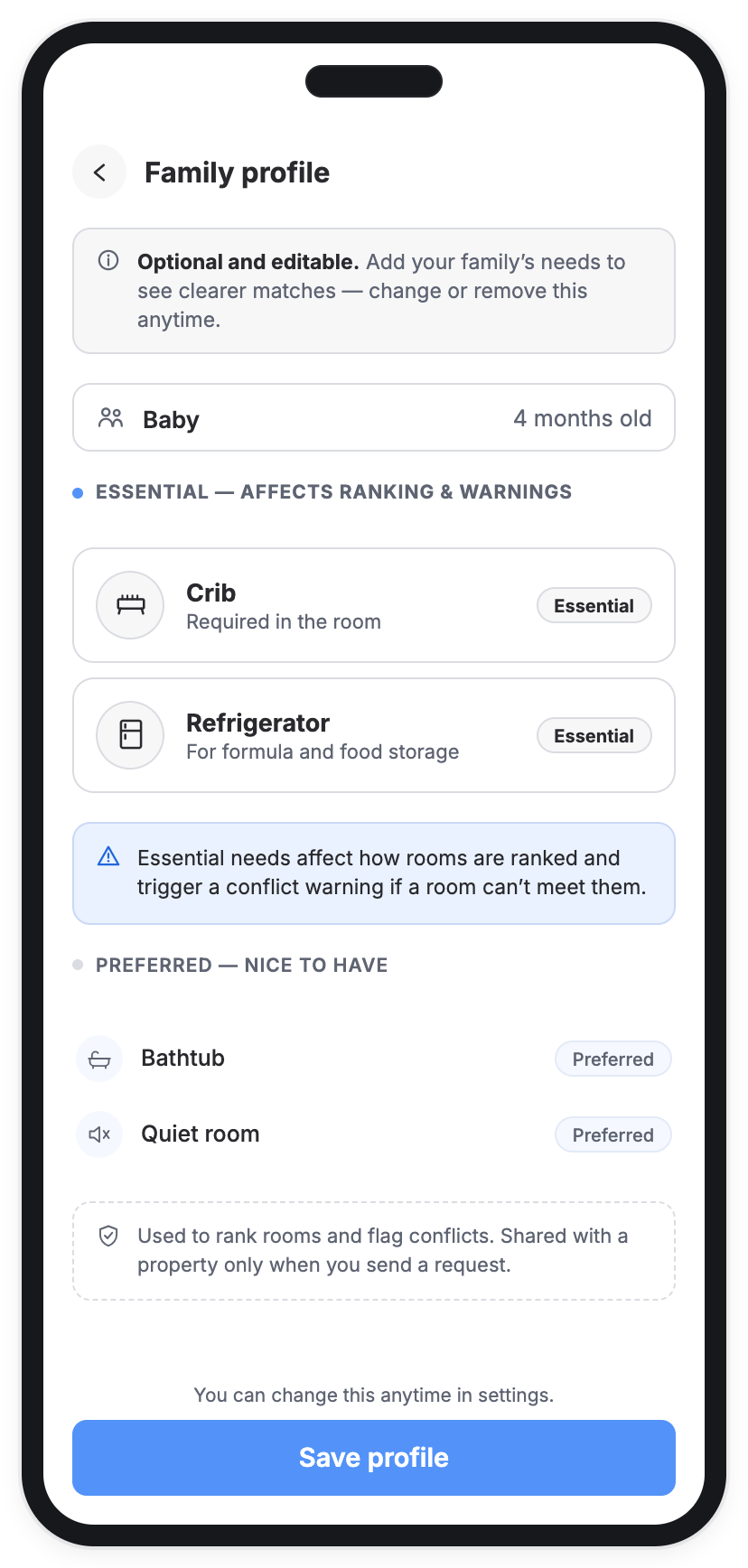
Start with what matters for this stay
Parents can create a lightweight family profile containing only the requirements that change accommodation fit.
Essential needs affect ranking, conflict warnings and recovery. Preferred needs personalize the experience without removing otherwise viable options.
The profile remains optional, reusable and editable.
Make practical fit visible in search
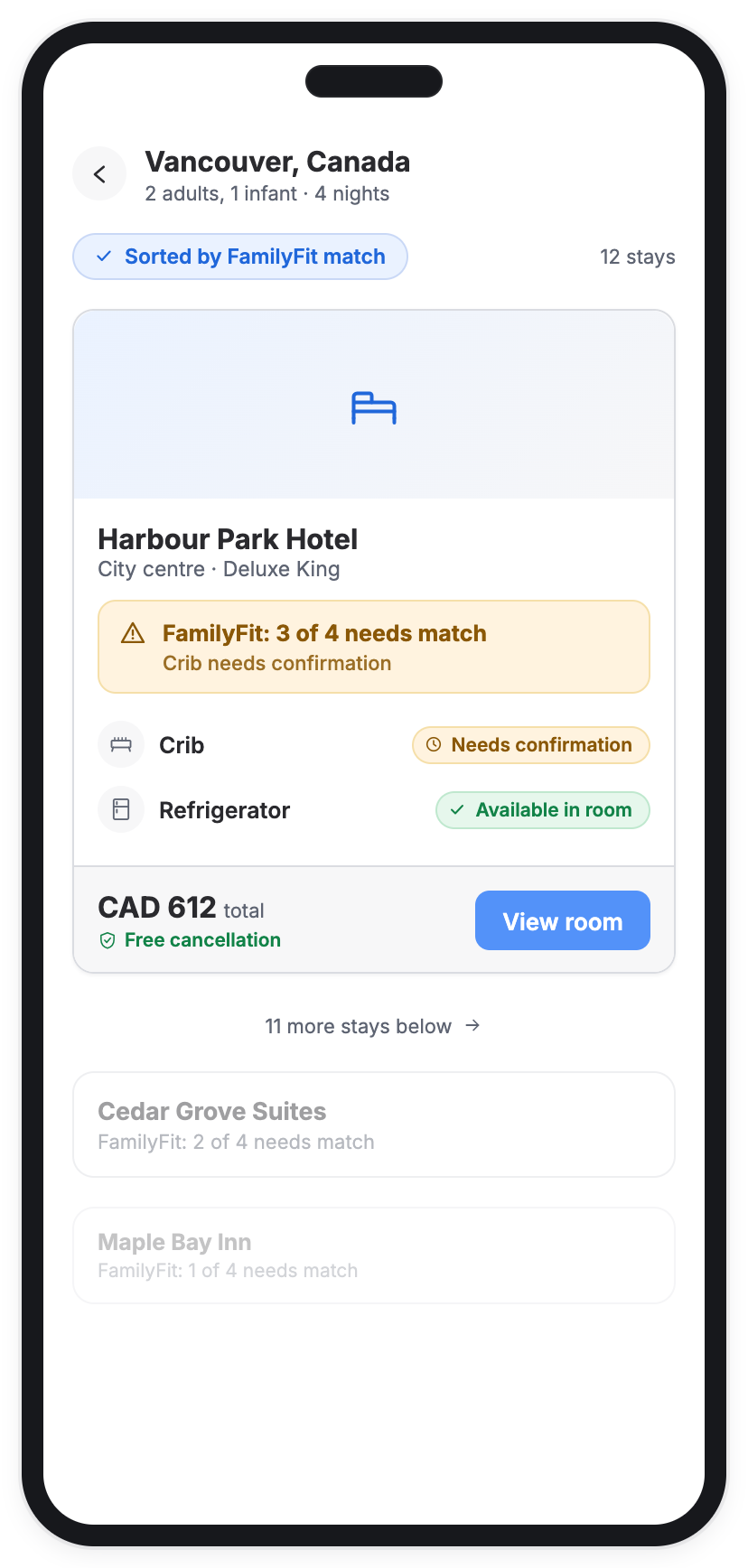
Search results explain why a property may work instead of hiding the reasoning behind a score.
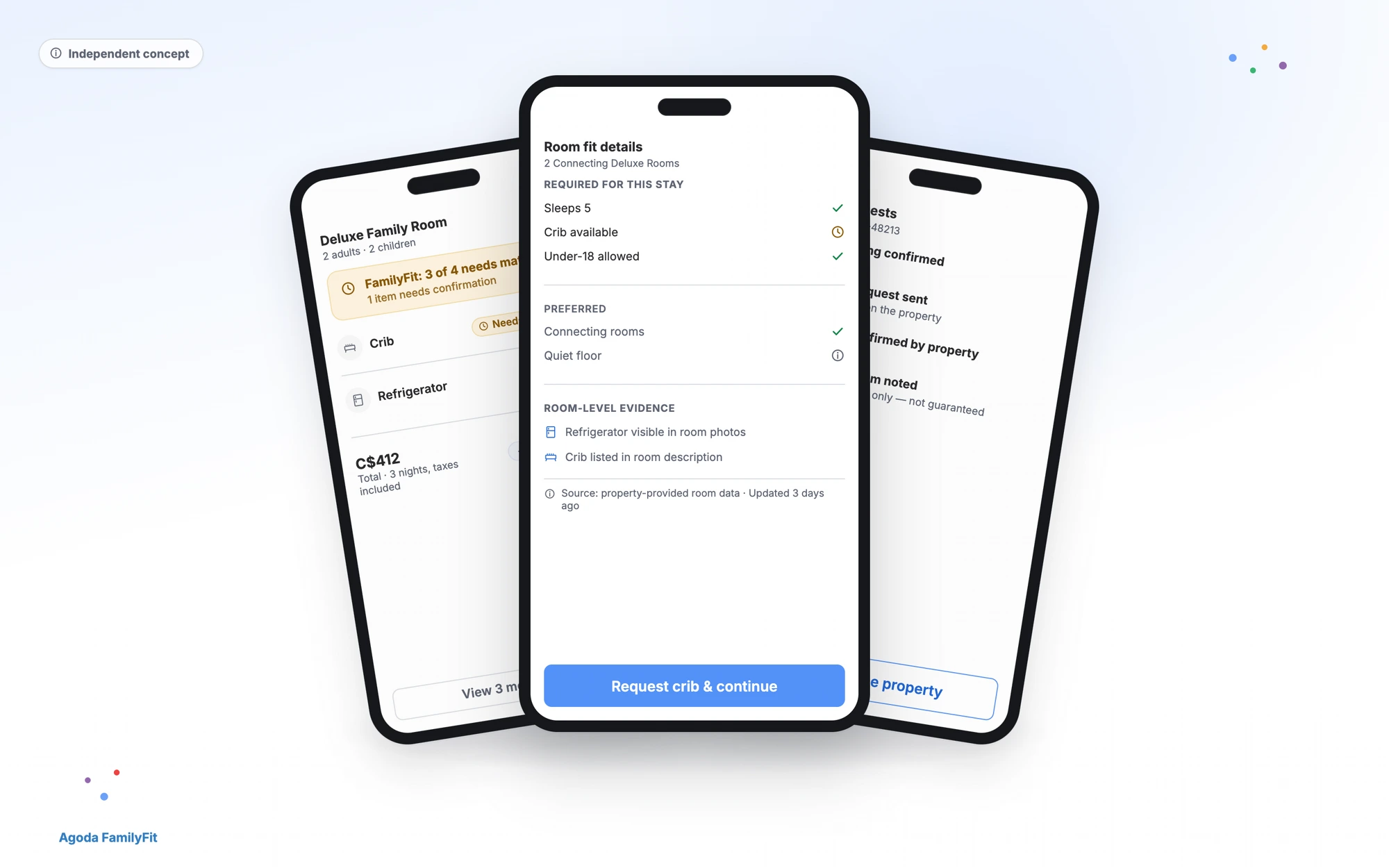
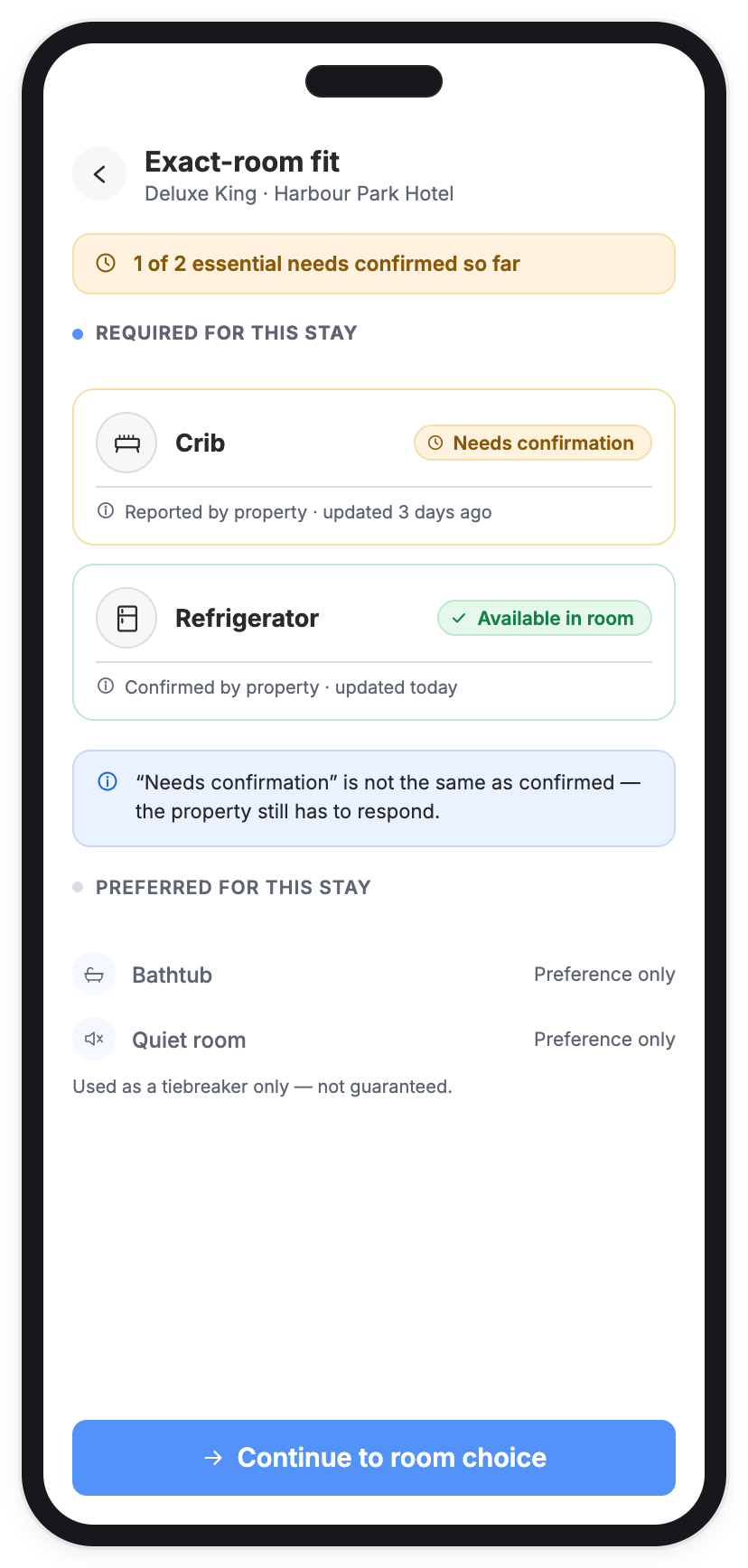
The parent can see that the room supports infant occupancy and includes a refrigerator while the crib still needs a property response. Price and cancellation remain visible because suitability cannot be separated from the booking decision.
Unknown information is shown honestly. It is not treated as either a match or a failure.
Attach evidence to the exact room
The fit view distinguishes room evidence, property-level data, special requests and missing information.
Requirements essential to the stay receive stronger hierarchy than preferences. The parent can see the source and freshness of each status instead of being asked to trust an unexplained match.
One principle remains non-negotiable:
“‘Available on request’ never becomes ‘confirmed’ until the property responds.”
Catch the conflict before payment
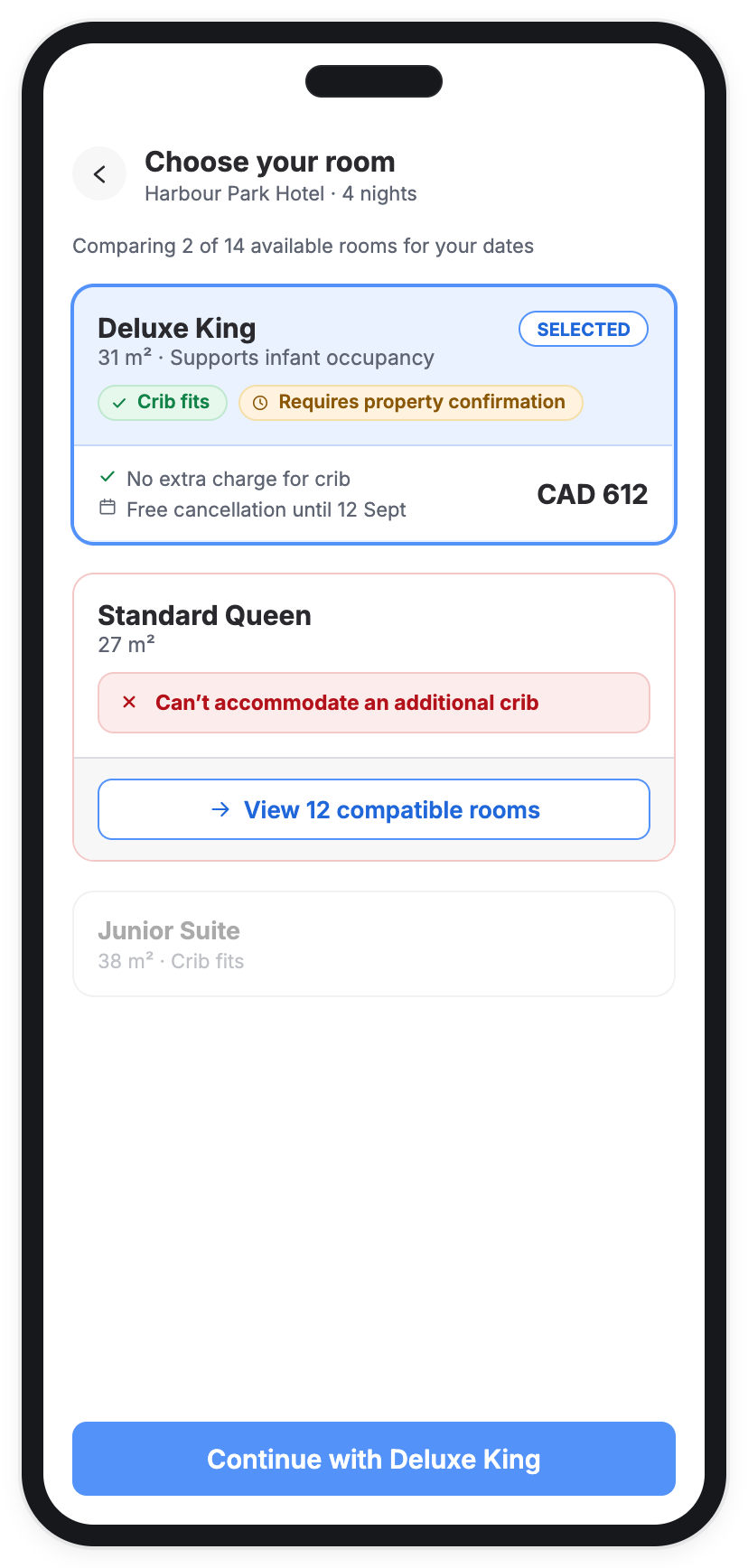
Room selection brings together capacity, crib compatibility, additional charges and cancellation conditions.
The Deluxe King supports the family but still requires crib confirmation. The Standard Queen cannot accommodate an additional crib, so the experience offers compatible rooms instead of ending with an error.
An unresolved request does not automatically block booking. Agoda explains the risk and keeps the cancellation window visible.
Give the request an ending
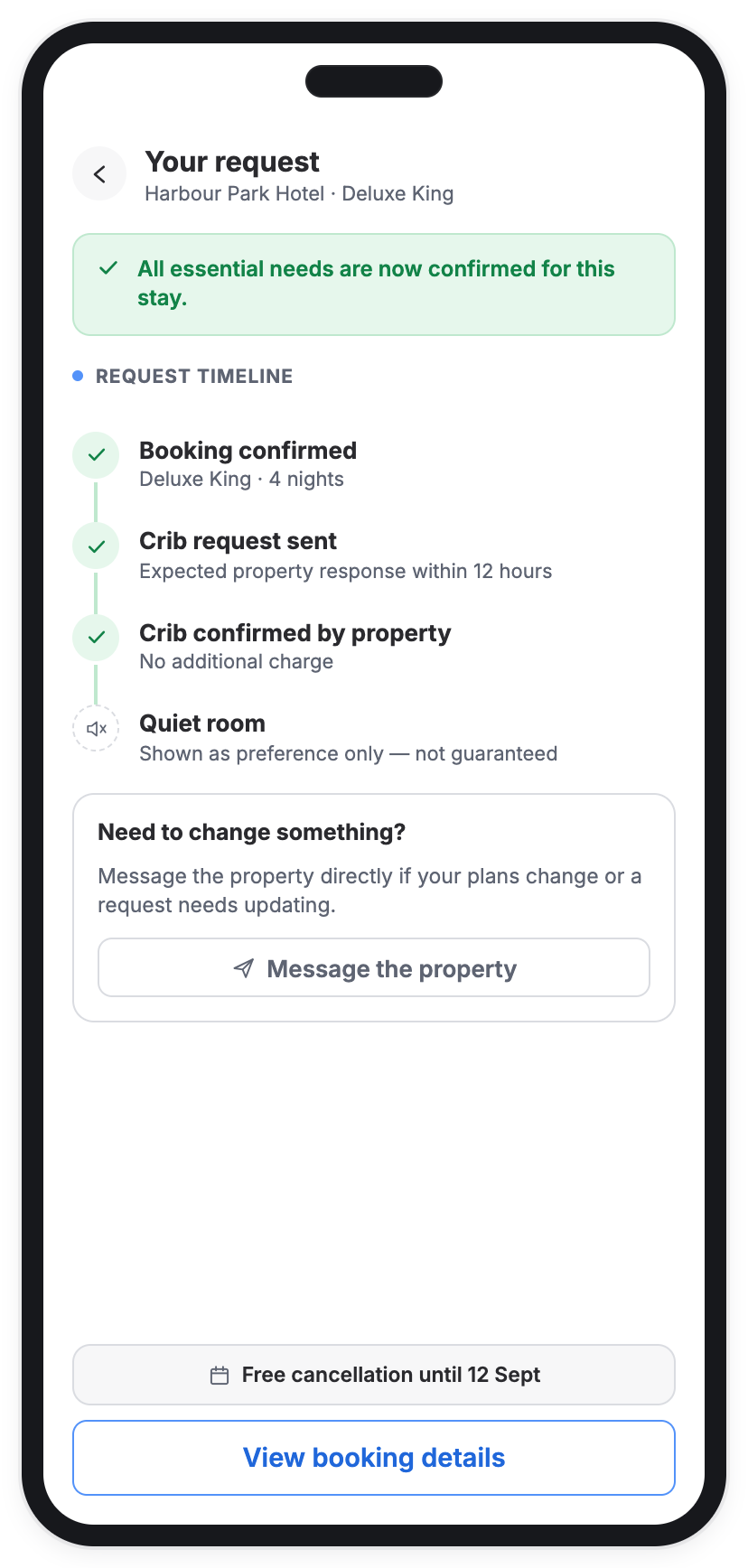
After booking, a tracker shows who owns the next action, when a response is expected and what the parent can do if the request fails.
Requested, confirmed, alternative offered, unable to fulfil and preference only are materially different states.
When an essential request cannot be met, the parent should see another room or a cancellation route while the booking is still changeable—not simply receive a failure notification.
07 · Property teams need a workflow for confirming requests
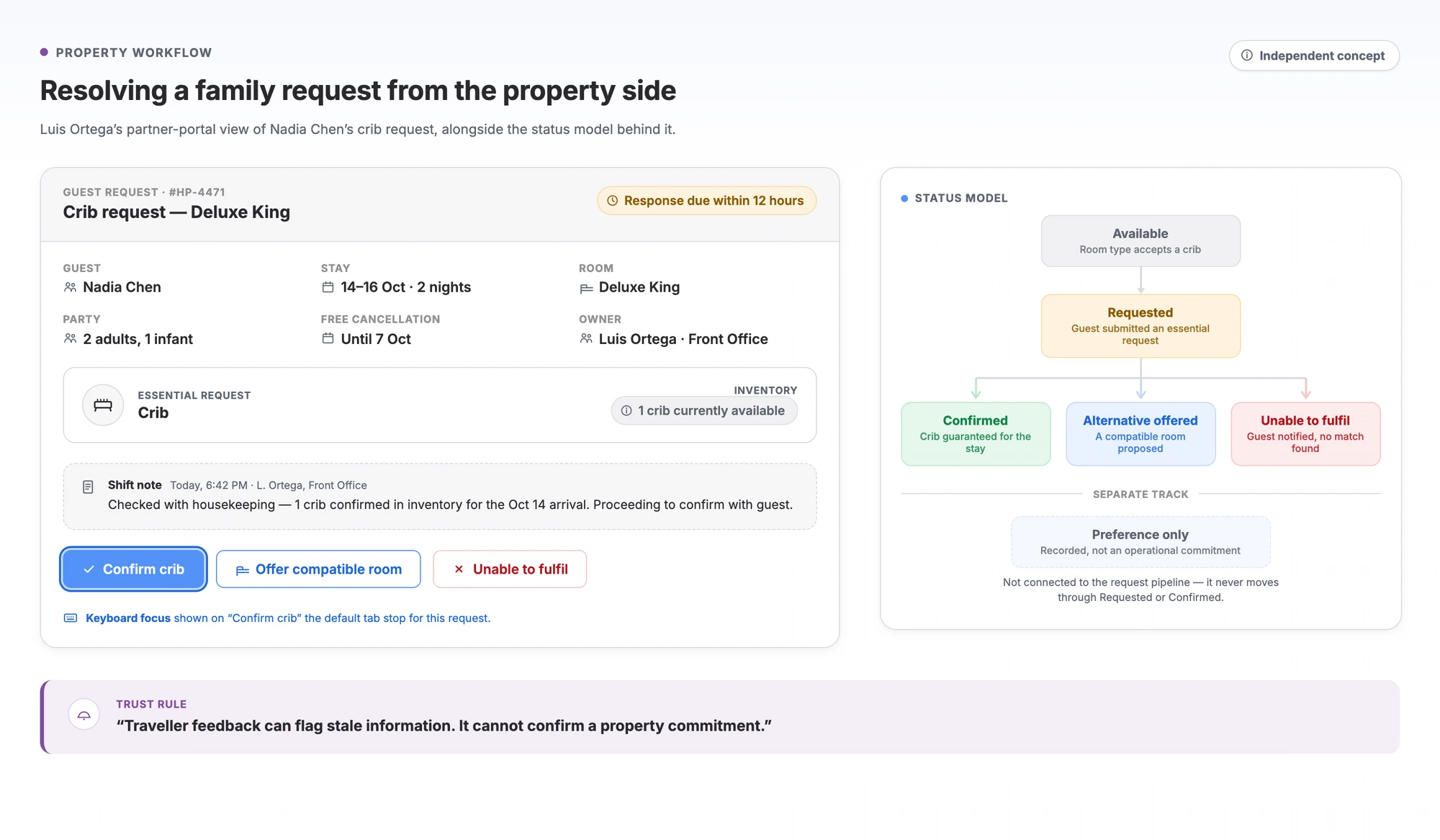
A confirmed crib is not merely a green label in the traveller interface. It is an operational commitment.
The property workflow gives Luis the selected room, family context, priority and response deadline in one place. He can confirm the crib, offer another compatible room or explain that the property cannot fulfil the request.
Each action is time-stamped and available across shifts, reducing duplicate messages and unclear ownership.
Traveller feedback can flag stale or conflicting information. It can never confirm a request on the property’s behalf.
08 · Starting before the data is perfect
Universal room-level information would not exist on day one. FamilyFit therefore needs to create value while coverage is still incomplete.
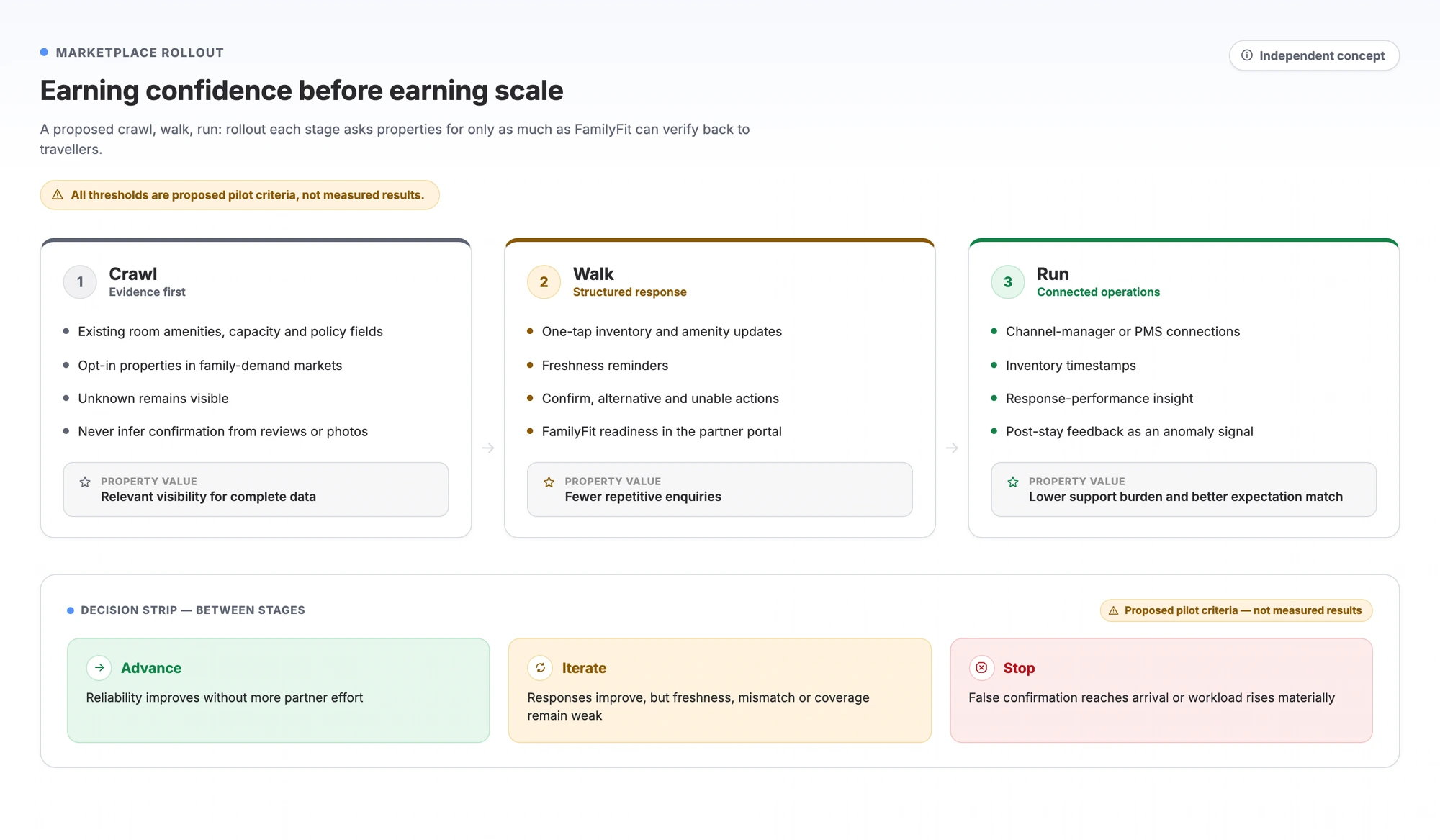
Crawl: Start with opt-in properties that already have reliable room, capacity and policy data. Unknown information remains visible.
Walk: Introduce structured amenity updates, inventory reminders and clear response actions. Better data can earn relevant family-search visibility and reduce repetitive enquiries.
Run: Connect room information to channel managers or property-management systems, add freshness timestamps and use post-stay feedback as an anomaly signal.
The pilot advances only if reliability improves without materially increasing property work or hiding too much viable inventory.
09 · How I would validate it
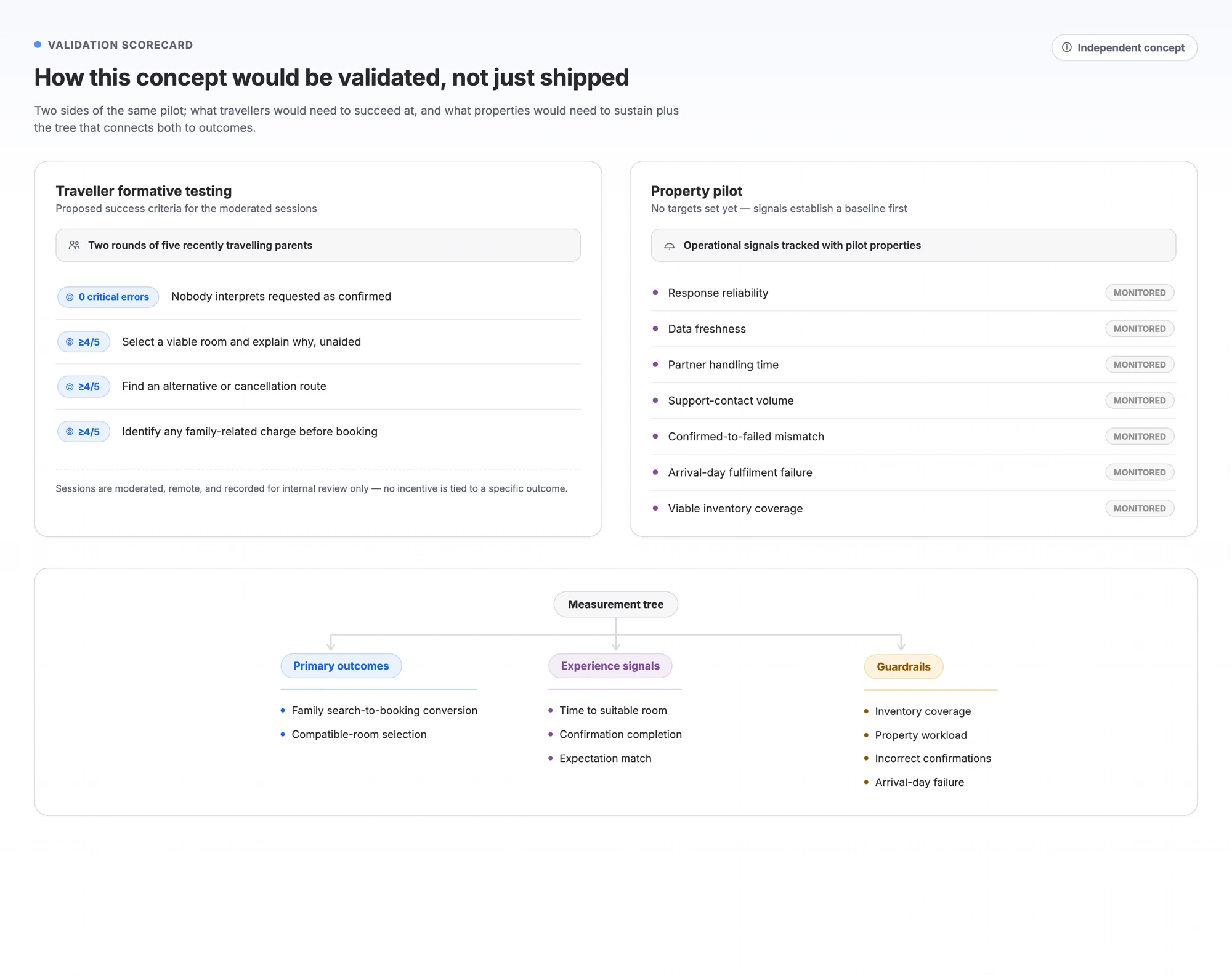
The first formative study would use two rounds of five parents who recently booked accommodation with a baby.
The proposed decision gates are intentionally demanding:
- Nobody should interpret “requested” as “confirmed.”
- At least four of five should choose a viable room and explain their reasoning without moderator help.
- At least four of five should find an alternative or cancellation path after a failed request.
- At least four of five should identify family-related charges before booking.
The property-side pilot would compare response reliability, data freshness, handling time, support contacts and confirmed-to-failed mismatches against the current process.
Primary product measures would include family search-to-booking conversion and compatible-room selection. Inventory coverage, property workload and arrival-day fulfilment failures would act as guardrails.
These are proposed thresholds and measures—not usability findings, business impact or shipped results.
10 · What I would take forward
The strongest lesson was that this problem does not end at information architecture.
Once a product promises greater certainty, it must connect traveller needs, room data, property operations, response ownership and recovery. Without that service layer, a polished interface could make incomplete information feel more dependable than it really is.
The next step would be to interview four or five parents, speak with at least two hotel staff members and test the status model inside Agoda’s current journey.
The personas, journey and proposed workflow would then change only where the evidence supports a change.
The next step would be to interview parents, speak with hotel staff and test the status model within Agoda’s existing booking journey. The concept should change wherever primary research contradicts the current assumptions.